
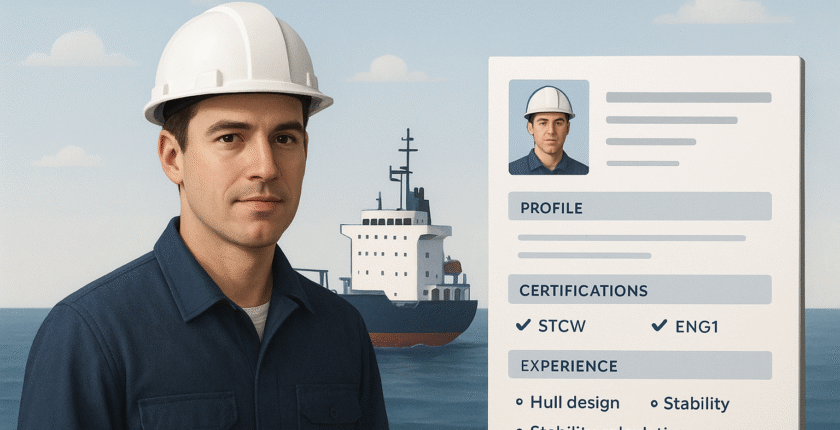
HOW TO WRITE A CV THAT GETS YOU HIRED (Examples Included)
Your CV is your first impression. Especially in the maritime industry, where recruiters receive hundreds of applications for roles at sea, in shipyards, and offshore. A strong, structured CV can be the difference between getting a callback and being overlooked.
Whether you’re applying for a role as an engineer, architect, or related to project management, your CV should clearly reflect your qualifications, your experiences, and the diplomas and certifications that prove you’re ready for duty.
Step 1: Start with a clear structure
Recruiters often spend less than 10 seconds scanning a CV. So, make sure it’s easy to read and logically structured.
Essential sections to include:
- Personal Information – Full name, nationality, contact details, and date of birth.
- Profile Summary – A short paragraph (3–4 sentences) describing who you are, your experience level, and what kind of roles you’re seeking.
Example: “Motivated Marine Engineer with 5+ years of experience in offshore operations and extensive knowledge of engine maintenance aboard LNG vessels.”
- Certifications – List valid maritime certificates such as STCW, ENG1, GMDSS, or DP Operator License.
- Work Experience – Include vessel types, tonnage, position, and contract duration. Additionally, add sea service records.
- Education – Maritime academy, training programs, and technical courses.
- Skills – Navigation systems, safety management, machinery operation, teamwork, communication, etc.
Step 2: Highlight your certifications
In the maritime world, certificates are currency. They prove compliance with international standards and instantly tell a recruiter whether you’re qualified for a role.
Be specific and structured:
- STCW Basic Safety Training – Valid until March 2027
- ENG1 Medical Certificate – Issued June 2024
- Dynamic Positioning (DP) Basic Course – Nautical Institute Certified
Adding expiry dates shows attention to detail, something a recruiter highly values. Plus, attention to detail is a frequently asked trait to bring.
Step 3: Quantify your experience
Whenever possible, use numbers and vessel specifics to add credibility.
For example:
- Developed 3D hull models and stability calculations using AutoCAD and Rhino for a series of offshore support vessels.
- Assisted in the structural design review of a 120-meter patrol vessel, focusing on weight optimization and steel thickness calculations.
- Prepared detailed general arrangement drawings (GA) and machinery layout plans in compliance with IMO and class regulations.
- Supported performance analysis and propulsion calculations for hybrid-powered ferries, contributing to a 10% fuel efficiency improvement.
This gives a recruiter a quick, factual overview of your experience level.
Step 4: Tailor your CV for each role
A common mistake? Sending the same CV to every vacancy.
If you’re applying for a naval architect position, emphasize your experience with drawing designs and models, your involvement in conceptual and basic designs, and with technical feasibility.
If it’s a lead, senior, or manager role, focus on your general experience within the specific discipline, your experience working with and within project teams, and your experience with leading subordinates.
Customizing your CV for the type of vessel or project/operation, years of experience, or specific traits significantly improves your chances of being shortlisted.
Step 5: Add a professional touch
- Include a professional photo (especially for international applications): A simple headshot in uniform or neutral attire works best; keep the background neutral, too.
- Keep formatting clean: avoid colorful templates. A white background, simple font (Arial or Calibri, or Times New Roman), and consistent spacing look most professional.
- Save as PDF: to preserve formatting when you send your CV via email or upload it online.
Step 6: Include a strong motivation statement (Optional but Powerful)
If the application platform allows it, add a short personal statement or motivation line. Not to confuse it with a motivational letter. In the motivation statement, you can add something simple but direct: “I’m eager to bring my technical knowledge and safety-first mindset to your offshore operations.”
It shows initiative and humanizes your CV.
Step 7: Keep your CV up to date
Maritime recruiters value accuracy. Always update your CV when you:
- Completed a new contract or a project;
- Renewed a certificate;
- Learned a new technical skill;
- Spent time at sea.
Be aware! Outdated details (like expired STCW or ENG1 certificates) can immediately disqualify you.
Final tip: pair your CV with a strong LinkedIn profile
In the maritime industry, LinkedIn is gaining ground. Many recruiters cross-check your online presence, or they find you on LinkedIn before you’ve reached out to them.
So, add a link to your profile in your CV, and keep your LinkedIn headline, all of your experiences, and diplomas and certifications consistent with your CV. This strengthens your credibility.
Ready to find your next maritime job?
Now that your CV is shipshape, it’s time to put it to use. Explore our latest vacancies and take the next step in your maritime career.